What church education systems need (and don’t)
A principles-first look at helping churches keep teaching continuous—without turning discipleship into a ChMS feature list.
When churches talk about “education systems,” the conversation often jumps straight to software.
Rosters. Check-in. Curriculum PDFs. Permissions. Integrations.
Those things can matter. They’re also easy to confuse with the actual job: helping people learn Scripture together over time—and still remember what they learned when the quarter ends.
This post is principles-first. Not a product tour.
The job of church education
At its best, church education helps the body:
- Hear Scripture in community
- Grow in shared understanding over seasons
- Form people who can teach others eventually
- Keep continuity when leaders rotate and life interrupts
That’s bigger than a class. It’s also more human than a content library.
Education for the church should never mean replacing pastors, friends, or the gathered body. Tools only help. Humans still teach humans.
What a healthy system needs
1. A living trail of teaching
Not just “we covered Romans,” but a findable record of aims, passages, and what people wrestled with.
Without a trail, every semester is a reset. With a trail, new teachers inherit more than a box of dusty binders.
2. Continuity across rooms
Sermon → class → group → home should be allowed to rhyme. They don’t need identical outlines. They need recognizable shared Scripture and shared language.
See sermon series to small-group follow-up for the midweek bridge.
3. Return built into the rhythm
Exposure without return is how lessons evaporate by Monday. A system that only schedules meetings but never prompts retrieval will keep producing spiritual amnesia with excellent calendars.
4. Clear ownership, light bureaucracy
Someone owns the spine of a series. Someone cares about teacher support. Someone notices when a room is stuck.
What you don’t need: twelve approval steps to update a discussion question.
5. Honesty about stages of faith
New readers and long-time readers share spaces all the time. Systems should make catch-up possible without shaming pace. “Open chair” is a pastoral design choice, not a software toggle.
What systems don’t need
They don’t need to become your ChMS. Membership, giving, rooms, and childcare are real problems—and they’re a different category than “how learning lasts.”
They don’t need AI to manufacture discipleship. Generated lessons can fill a hole in a pinch. They can’t love your people or remember last month’s tears. (More on that posture in notes-first vs AI.)
They don’t need infinite content. More videos won’t fix a missing trail. Sometimes the church needs fewer inputs and better memory.
They don’t need to track holiness. If your education stack starts feeling like spiritual surveillance, you’ve lost the plot.
A practical church audit
Ask these in a staff or teachers’ meeting—no software required:
- Where does last quarter’s teaching trail live today—really?
- Can a new teacher find what the previous teacher learned about this group?
- Do sermon, class, and group ever share a deliberate bridge?
- What happens on Monday after a strong Sunday?
- Which tools help humans teach—and which tools ask humans to serve the tool?
Write the answers down. The gaps will be obvious.
Where Harvous fits (honestly)
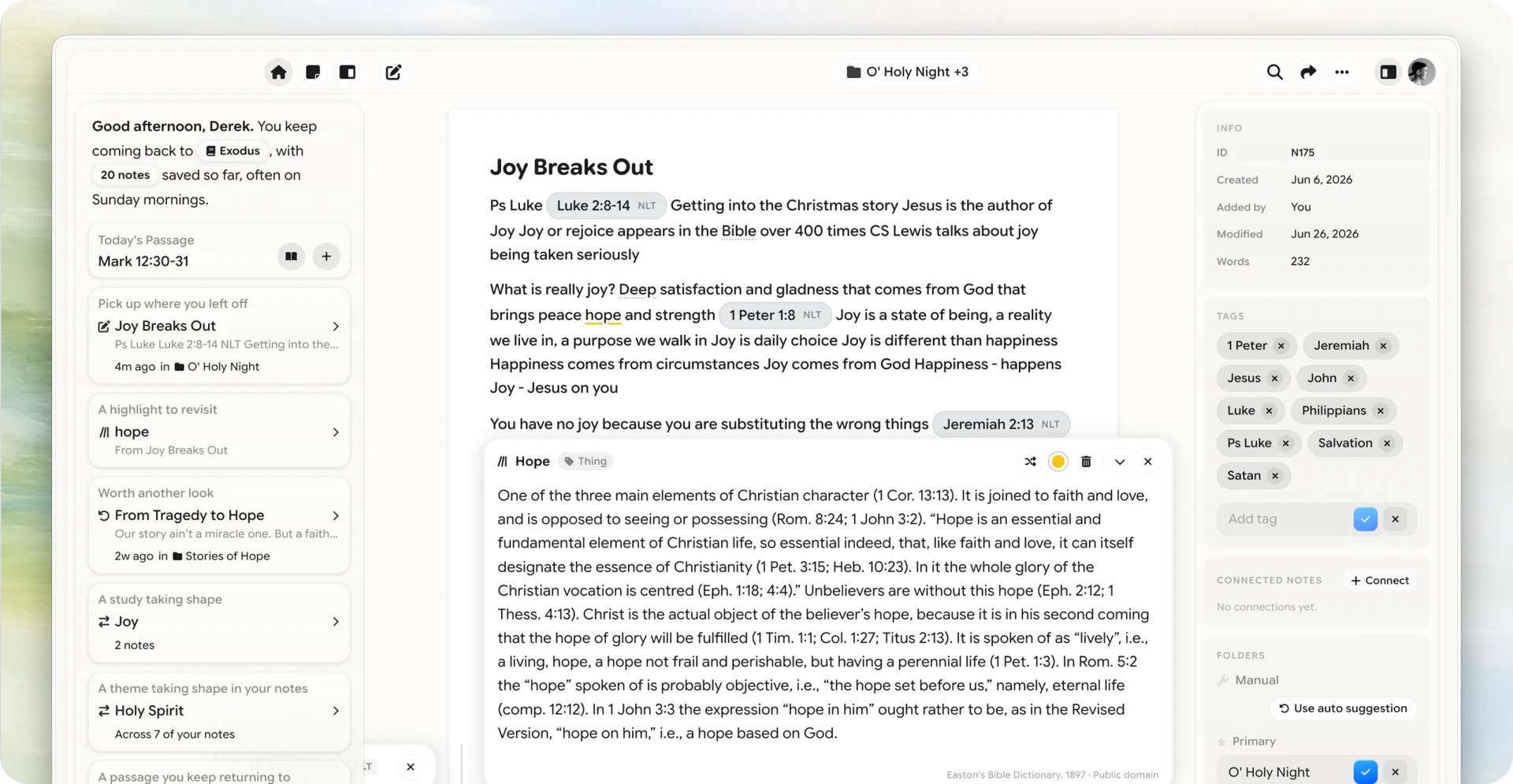
Harvous helps individuals and teachers keep scripture-linked notes—the personal and prep layer of the trail. Shared Spaces add a group layer: the same threads, opened so a class or small group can contribute together. Hosting is Harvous Plus; joining is free.
A church can keep the layer above that: a teaching plan for each ministry, a series that holds its weeks instead of a title retyped every Sunday, and roles that tell a pastor’s job from a teacher’s. What a church sees of it is a count—how many people are connected, how many follow each ministry. Never who wrote what.
We’re still not building a ChMS. We’re still not replacing the body.
Church onboarding is by request while this is young, so the honest next step is a conversation, not a feature checklist: Harvous for churches.
Principles, not platforms
You can improve church education this month with:
- One-sentence aims for each gathering
- Passage-linked trails for teachers
- A Monday return habit
- A bridge between Sunday and midweek
Software may amplify those later. It can’t invent them if the principles aren’t there.
A tool can help you keep what a room found. It can’t teach anyone, and it was never meant to be the church.