Keep what the group finds
Your group has real discoveries in the room—then the hour ends and most of it vanishes. Here’s how to keep the trail without turning study into admin.
Your small group just had a good night.
Someone asked a question that opened the text. Someone else connected James to a hard week at work. You landed a question worth carrying into next week.
Then people stand up. Chairs scrape. The parking lot conversation takes over. By Thursday, the best thought from the room is a vague feeling that something landed.
This is the quiet tax of church education: the group finds things the group can’t keep.
When the hour ends
Personal notes help the leader. They don’t automatically help the room.
You may go home and write a sentence in your own study Bible. A faithful member may jot something in a journal nobody else will see. The substitute who covers next month inherits a PDF of discussion questions—not the living thread of what this group already wrestled with.
If you’ve felt church education evaporate by Monday for one person, multiply that by twelve people who met in a living room. The fade is social.
Learning lasts when people get a chance to come back to what they heard—not only when they once nodded along.1
What a shared trail is
A shared trail is not a transcript. It’s not minutes. It’s not “who said what” for the record.
It’s enough continuity that next week’s gathering isn’t a reboot:
- The passage you were in
- One question that opened the room
- One discovery someone wants to remember
- One open thread for next time
That’s closer to a handoff without amnesia than to a content archive. It’s what PDFs alone can’t hold.
Where trails usually die
They die in three familiar places:
Only in the leader’s head. Faithful. Fragile. When you’re sick, the trail walks out with you.
Only in a chat thread. Fast during the week. Impossible to find three months later when you’re in week four of James and someone asks, “Didn’t we already talk about this?”
Only in a Drive folder. Useful for worksheets. Bad at holding the living questions of this room.
The principle is simple: write the trail where the group already studies—not in a third app nobody opens between Sundays.
What Shared Spaces add
Shared Spaces are Harvous’s group layer on top of personal study.
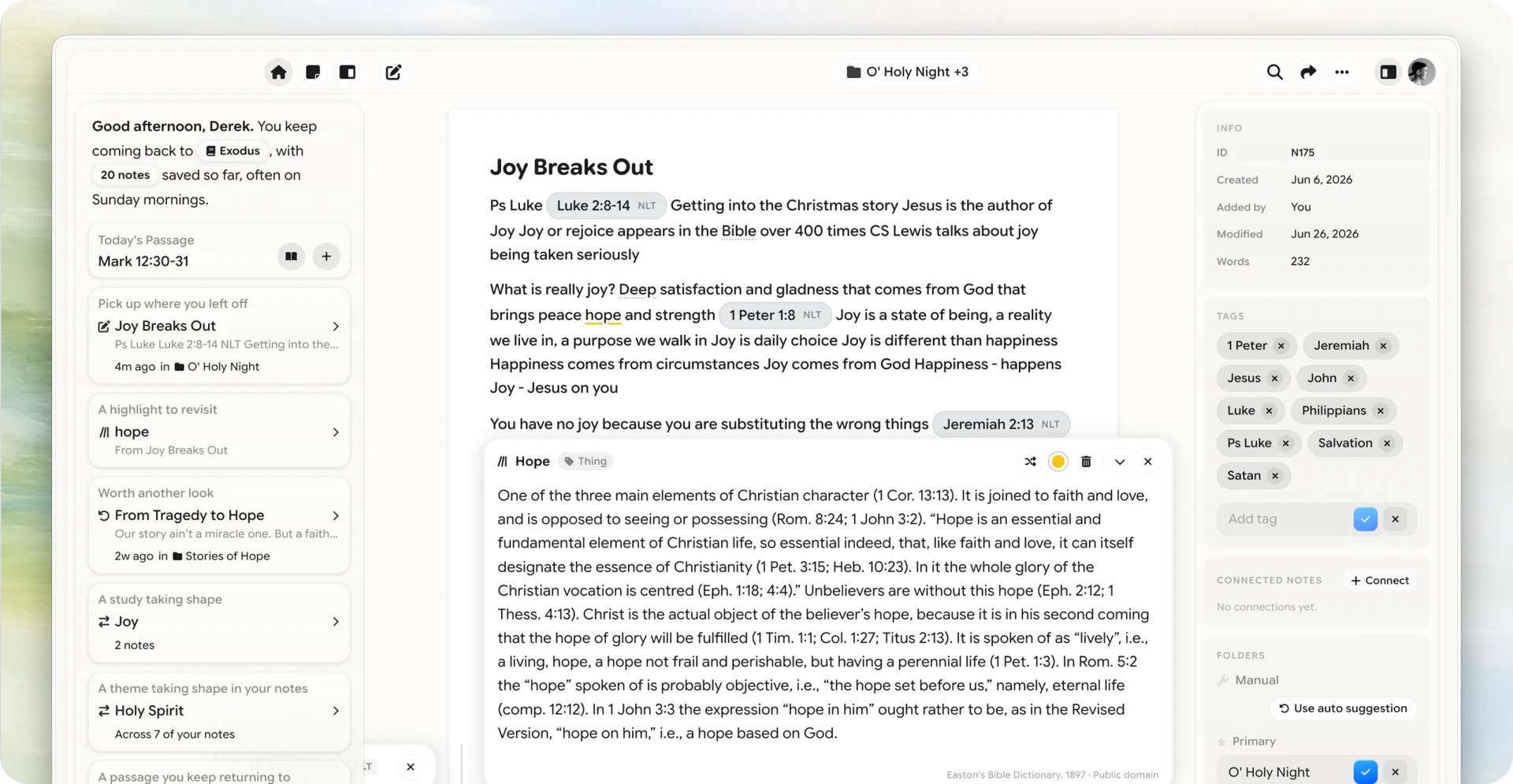
Your prep can stay private. What you choose to put in the space is what the group can see and add to. Same threads. Same scripture-linked notes. Same highlights—opened so the room can contribute, not only listen.
A practical shape:
- One space for the group or class
- One thread per week or topic (“James week 4,” not “everything”)
- Questions, answers, and references that live past the hour
Hosting a space is included with Harvous Plus. Joining is always free for members. You’re not asking everyone to buy a tool to participate.
This is not a church management system. It’s not curriculum delivery. It’s a place for what the group discovers together.
What they don’t replace
Shared Spaces don’t replace the gathered body. They don’t replace you as the human who teaches. They don’t invent continuity if nobody writes anything down.
Tools only help. Humans still teach humans.
Church-level continuity exists now—a teaching plan per ministry, a series that holds its weeks, roles that tell a pastor’s job from a teacher’s. Onboarding is by request rather than a signup button, so the honest next step there is a conversation: Harvous for churches. Don’t wait on it to keep this group’s trail.
A light group habit
Try this for four weeks without overbuilding:
- Before you meet — start (or reopen) a thread for that week’s passage.
- In the room — capture one question and one discovery as they land. Not everything. The keepers.
- Before you leave — ask: “What should next week already know we found?”
- Between weeks — invite members to add a sentence if something follows them home.
If the habit feels heavy, shrink it. One shared note per week beats a perfect system nobody uses.
Group study is already happening. The discoveries are already real. The missing piece is usually a place those discoveries can live when the chairs go back against the wall.
If you lead a group or class, start at Shared Spaces—or with the quieter practice underneath it: leave a trail the room can return to. Group leaders and teachers already need that, with or without a new feature name.
Footnotes
-
For a teacher-facing overview of retrieval practice, see retrievalpractice.org. ↩