Why church education evaporates by Monday
Good teaching isn’t the problem. What happens after the gathering is. Here’s why lessons fade—and what teachers can do about it.
You taught a solid lesson on Sunday.
People nodded. Someone asked a real question. A verse landed in a way that felt shared, not forced. You walked out thinking: that one stuck.
By Wednesday, you’re not so sure. The thread of the class is hard to reconstruct. The takeaway you thought was clear has softened into “something about grace.” And you’re already prepping next week’s passage like last week never happened.
This isn’t because your church is shallow. It’s because most church education is designed for the room—and almost nothing is designed for the week after.
The fade isn’t a people problem
We tend to blame attention spans, busy calendars, or “people just don’t care like they used to.” Sometimes those things are real. But they’re not the whole story.
Learning research has a quieter explanation: people forget what they never get a chance to retrieve. Retrieval practice—the simple act of pulling something back from memory—is one of the most reliable ways learning lasts.1 Sitting through a lesson once is exposure. Coming back to it later is what turns exposure into something you can still use.
Church life is full of beautiful exposure. It’s thinner on return.
Sunday school, small group, the sermon—these are high-signal hours. Then Monday arrives with work, kids, texts, and a dozen open loops. The lesson doesn’t get rejected. It just never gets a second look.
What evaporates first
When a lesson fades, it usually fades in a predictable order:
- The structure — which passage, which arc, why you ordered it that way
- The connections — the cross-reference that made someone sit up
- The questions — the one that opened the room
- The personal edge — what you hoped would walk out with them
What’s left is a vague warmth. Warmth isn’t nothing. But it’s hard to build a discipleship path on warmth alone.
Teachers feel this most acutely because you’re holding the whole map. Your class only held a few trails. When even your map blurs by Thursday, next week starts from scratch instead of from continuation.
The missing layer: a trail
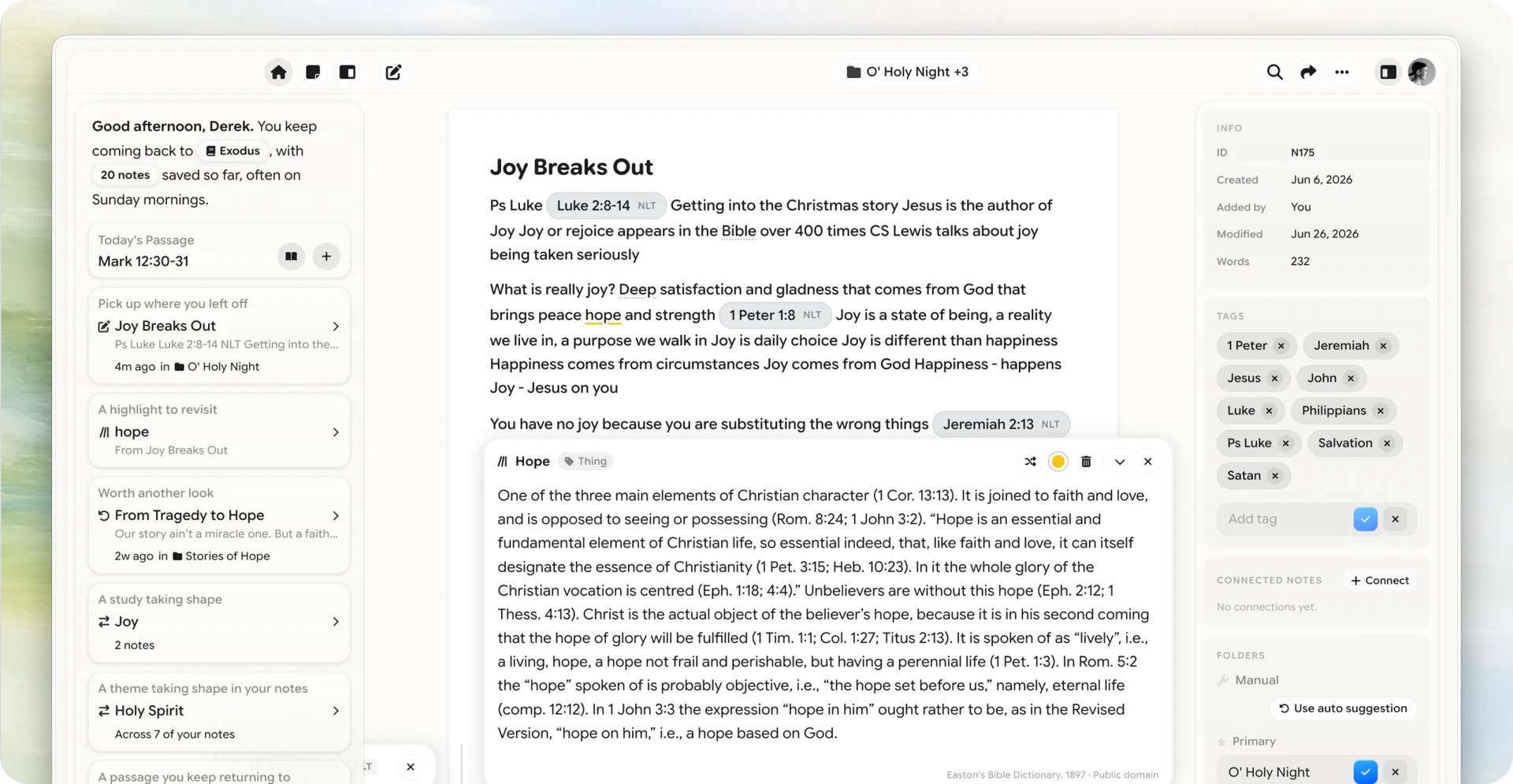
Good church education needs more than a good hour. It needs a trail—something that survives the gathering.
A trail can be simple:
- The passage and the one sentence you don’t want to lose
- Two questions worth asking again midweek
- A note on what people actually wrestled with (not what you planned)
- A link between this week and last week you can see at a glance
Without a trail, every Sunday is a standalone event. With a trail, you’re teaching a path.
This is why notes linked to Scripture matter more for teachers than for almost anyone else. You’re not journaling for vibes. You’re trying to keep a living thread of what the room is learning—so Monday doesn’t erase Sunday.
What this is not
It’s not a call to turn every class into homework. Most people won’t do a five-step follow-up plan, and that’s okay.
It’s also not a pitch for a church management system. You’re not trying to track attendance into holiness. You’re trying to keep what was already alive in the room from disappearing into the week.
Humans still teach humans. Tools only help. The body still gathers. The Spirit still works. A trail just means the good work of teaching has somewhere to live when the chairs are stacked.
A small Monday experiment
Next time you teach, try this before you close your laptop Sunday night:
- Write the passage reference.
- Write one sentence: what I hope they still have by Wednesday.
- Write one question you’d ask if you texted the group midweek.
- Put those three lines somewhere you’ll actually open again—ideally next to the verses, not buried in a random notes app.
That’s it. Not a curriculum overhaul. A trailhead.
If you teach regularly and want more practice for this kind of work, start at Harvous for teachers. And if you’ve felt this fade in your own study (not just your class), why Bible study thoughts keep disappearing is the personal version of the same problem.
Learning that isn’t kept isn’t learning for long. The church already knows how to teach. The open question is whether Sunday still has a place to land on Monday.
Footnotes
-
Practice testing and spaced practice are among the strongest classroom-ready techniques in learning research — see this APA teacher-ready review (PDF). ↩