Why scripture engagement stalls
Open to the Bible isn’t the same as a habit that sticks. Here’s what research names—and what teachers and serious readers can do about the gap.
You know the pattern. Someone opens a Bible app a couple mornings a week. They mean well. By Wednesday the verse is gone, the thought is fuzzy, and the week feels spiritually flat—not because they’re careless, but because exposure isn’t the same as return.
Teachers feel a classroom version of the same stall: a good hour on Sunday, then silence. Why church education evaporates by Monday names that fade. This essay zooms out to the habit underneath—why scripture engagement so often stalls short of something that actually sticks.
Research doesn’t replace pastoral wisdom. It does name patterns worth taking seriously.
The four-day wall
The Center for Bible Engagement’s multi-year work keeps landing on a stubborn threshold: engaging Scripture four or more days a week looks radically different from engaging it less often.1
One to three days a week? Across their findings, the behavioral picture is close to people who barely engage at all. Cross into four-plus days, and the differences show up—including things like memorization and sharing faith. The point for teachers and daily readers isn’t to chase outcome percentages. It’s simpler: sporadic touches rarely move the needle.
That matters if your whole stack is built for “open once and feel inspired.” Inspiration isn’t a rhythm. Rhythm is return—same text, same trail, enough days that the week has a spine.
Tools don’t create that spine. People do. But tools can make return easier or harder.
Bible Disengaged
The American Bible Society’s State of the Bible tracking draws a hard line between being friendly toward Scripture and being Scripture Engaged. In 2024, 57% of U.S. adults were Bible Disengaged; only about 18% were Scripture Engaged.2
Plenty of people sit in the middle—curious, open, even “Bible friendly”—without a habit that shapes how they decide and live. The gap isn’t always hostility. Often it’s sustainability: people don’t know how to bridge a verse they read and a thought they can still find next month.
If you’ve watched a class nod along and then forget the passage by midweek, you’ve seen the same cliff up close. Why Bible study thoughts disappear is the personal version: storage and connection problems dressed up as memory problems.
Access isn’t digestion
More people carry a Bible in their pocket than any generation before them. Digital readers and notifications lowered the cost of opening a passage. That’s good.
It hasn’t automatically fixed retention. Access gets you to the text. Digestion is what you do with it—write the sentence, link the verse, come back later. Learning research keeps saying the quiet part: retrieving what you heard beats highlighting it once.
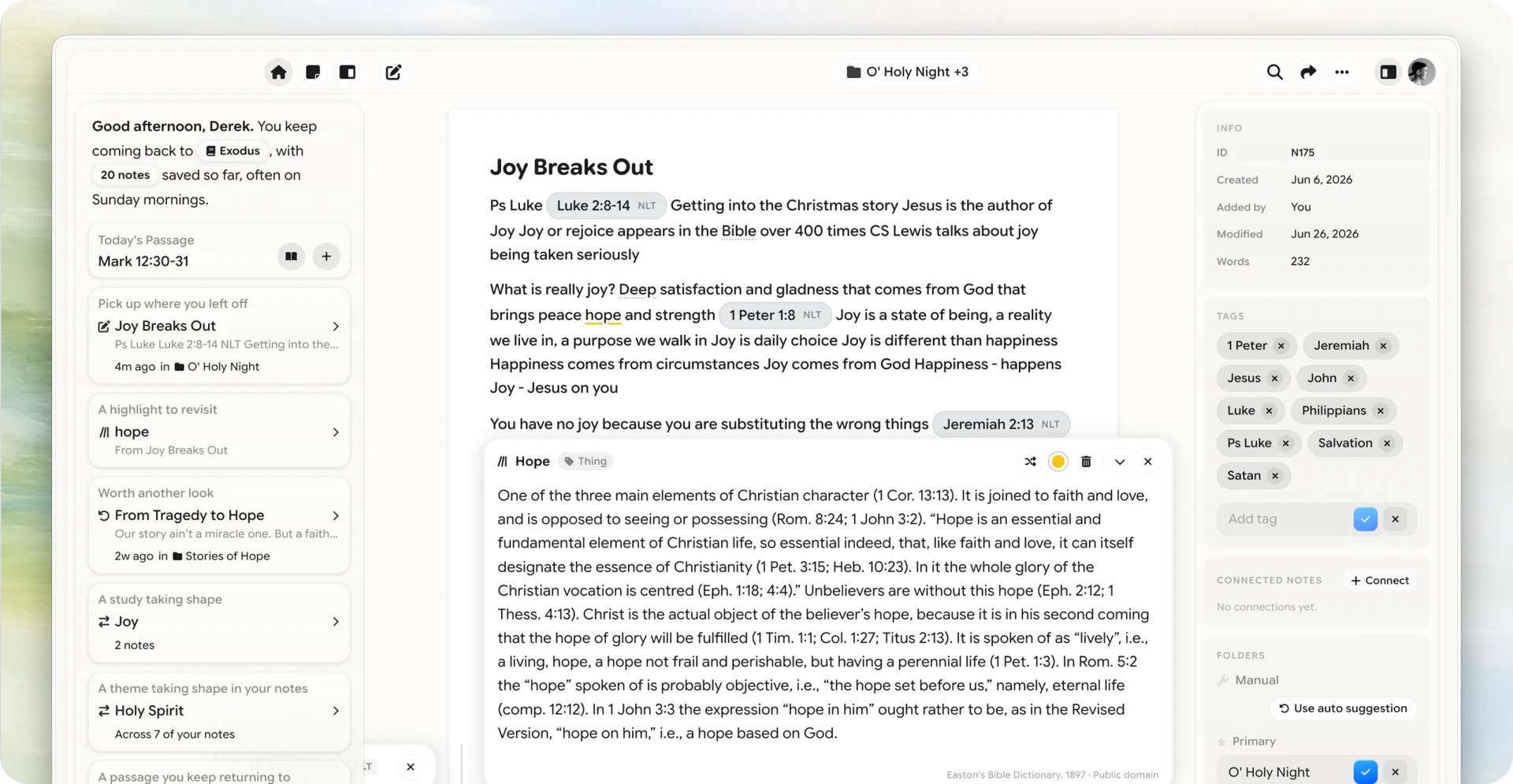
So the stall isn’t “we need one more app that pings harder.” It’s that churchgoers often bounce between a passive reading app and a generic notes app that doesn’t know what a verse is. The missing piece is a place built for study after the open—not instead of your reader.
Keep your Bible app. Add a notes hub. That pairing is the whole posture.
Young adults want depth
Barna’s State of the Church tracking shows a sharp rebound in weekly Bible reading among younger adults—about 50% of Millennials and 49% of Gen Z reporting weekly engagement in 2025, after a deep low the year before.3
They’re showing up to the text. What they tend to reject is the thin version of “engagement”: checklists without curiosity, streaks without substance. Digital-first doesn’t have to mean shallow. It can mean interconnected—notes linked to scripture, threads that grow over a series, recall that resurfaces what mattered.
If you teach Gen Z or Millennials, the invitation isn’t louder guilt about reading plans. It’s an intentional workspace for depth: capture what they find, keep it findable, practice return. The Monday retention loop is one light rhythm for that.
What a notes hub helps
None of this research proves an app can transform a soul. Humans help humans. Tools only help.
What a notes-first hub can help with is the practical stall:
- A place for the thought after the verse
- Scripture linked to your words, not trapped in a margin you can’t search
- Threads so a theme compounds across weeks
- Recall so return isn’t left to chance
That’s the work Harvous is for—study notes that stay connected to the text. Soft start if you want one: for daily readers or for teachers.
The four-day wall, Bible Disengagement, and younger adults opening Scripture again all point the same direction: engagement that lasts is engagement you can reopen. Build for digestion and return—not only for the notification that got you to open the app.
Footnotes
-
Center for Bible Engagement, “Scientific Evidence for the Power of 4” and overview at the Center for Bible Engagement. Their synthesis finds little difference between 1–3 days/week of engagement and near-none—while 4+ days/week correlates with large behavioral and spiritual-growth differences. ↩
-
American Bible Society, State of the Bible 2024: 57% Bible Disengaged, 18% Scripture Engaged among U.S. adults. ↩
-
Barna Group / Gloo State of the Church, “Gen Z and Millennials Fuel a Bible Reading Comeback” (2025): weekly Bible reading ~50% Millennials, ~49% Gen Z. ↩