Notes-first vs AI that studies for you
AI can summarize a passage in seconds. That might be exactly the wrong kind of help for Bible study—and for church education.
There’s a new category of “help” showing up around Scripture.
Paste a passage. Get a summary. Ask a chatbot for three applications. Generate discussion questions for small group. Receive a devotion that sounds polished before you’ve read the text twice.
Some of that can be useful—like a study Bible footnote you didn’t have to dig for. I’m not anti-tool. I built a tool.
But there’s a line I won’t cross in how Harvous thinks about study: the search is yours.
If a system does the searching for you, it may feel efficient. It can also quietly displace the one part of Bible study that forms you—especially if you never get a turn in the text yourself.
What notes-first means
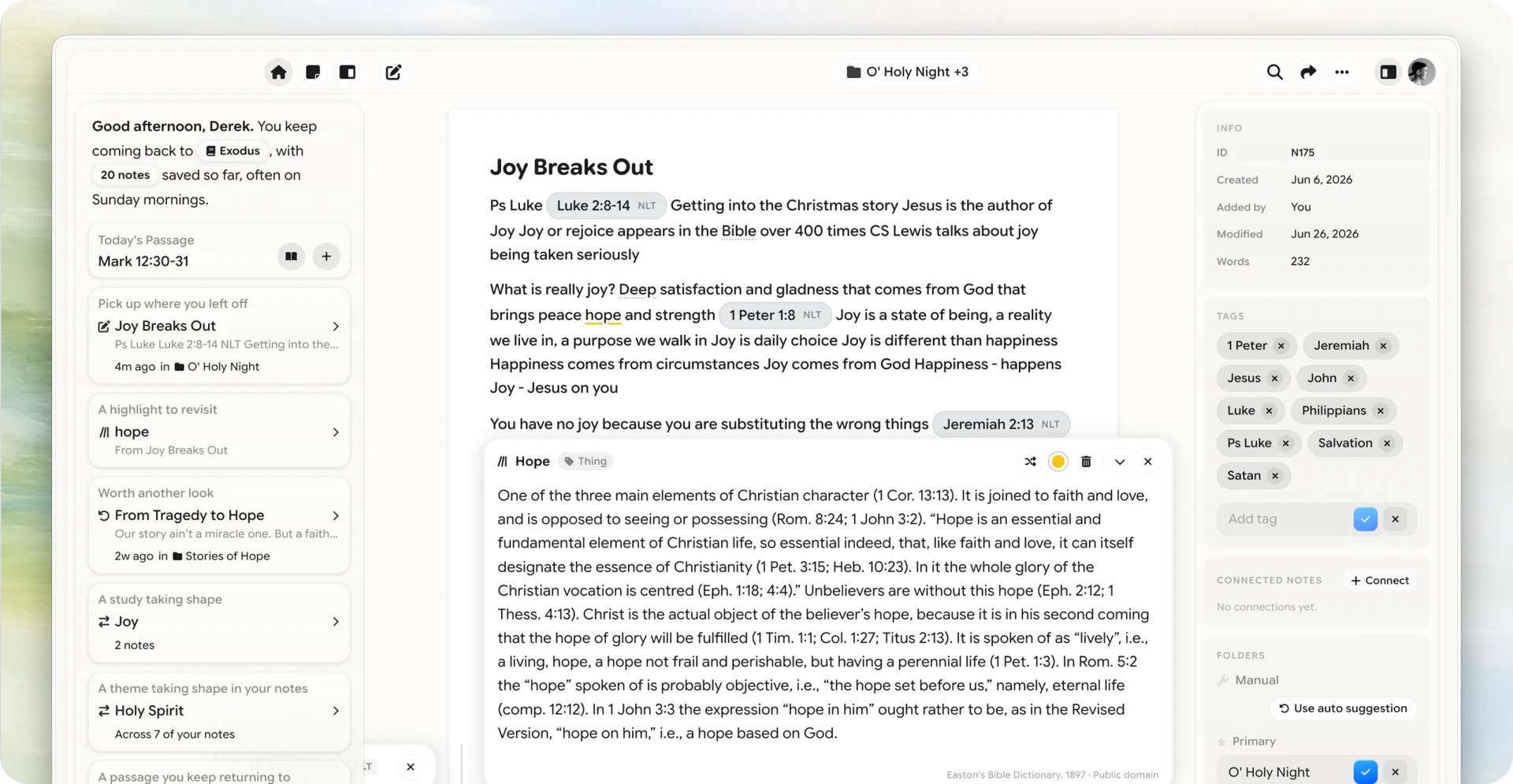
Notes-first means the primary artifact of study is your encounter with the text—captured, kept, connected—not a generated explanation that replaces the encounter.
You still use commentaries. You still ask friends. You still listen to teachers. Humans help humans.
A notes-first tool just refuses to pretend that an autocomplete of spiritual language is the same thing as attending to Scripture.
This is why Harvous isn’t an AI study buddy that “does the passage for you.” It’s a place for what you notice to live—linked to the verses you’re actually in, whether you typed the reference or read the chapter right there.
Where AI helps vs. flatters
AI can help with:
- Finding a cross-reference you half-remember
- Explaining a historical term quickly
- Drafting a schedule or outline you will rewrite
AI flatters when it:
- Produces an application before you’ve sat with the text
- Gives you “group questions” that sound deep and cost you nothing
- Summarizes away the friction that makes reading slow enough to see
Friction isn’t always the enemy. In study, a little friction is often the point.
The unofficial rules for AI apps for Christians put this in plain language: tools should not replace human relationships or spiritual practices, should not fabricate Scripture, and should stay honest about what they are. That posture matches how we want to build.
Why the stakes are higher
If you’re teaching, AI-generated lessons are especially tempting. You’re tired. The week got away from you. A clean outline appears in ten seconds.
The risk isn’t only accuracy—though accuracy matters, and models still invent confident nonsense.
The deeper risk is formation. Teaching is one of the ways you keep learning the text. If prep becomes prompting, your trail gets thinner even as your slides get prettier.
Your class doesn’t need a more synthetic hour. They need a human who has been with the passage long enough to have a real aim, a real question, and a real memory of what this group has already walked through.
Proverbs and the name
Harvous takes its posture from a line that has stayed with me—Proverbs 25:2:
It is the glory of God to conceal a matter; to search out a matter is the glory of kings.
(See Proverbs 25:2.)
I’m not claiming every believer is a king, and I’m not turning one proverb into a full theology of technology. I am saying the searching matters—and a tool that quietly removes the search can take something formative with it.
That doesn’t mean tools are bad. It means tools should serve the searching—not replace it.
(If you want the longer personal version of this, What Proverbs 25:2 taught me is where that thread started.)
A practical rule of thumb
Before you accept AI help in Bible study or teaching prep, ask:
- Have I read the passage myself first?
- Am I asking for a pointer—or for a substitute encounter?
- Will I keep a note in my own words afterward?
If the answer to #3 is no, the “help” may be training you to consume explanations instead of keeping learning.
Humans help humans. Tools only help. Notes-first is how we try to keep that order straight.