What your church never sees
Church software keeps offering to tell a pastor who is engaged and who has fallen off. Why Harvous shows a church counts and nothing else—and why that had to be a design decision, not a setting.
Sooner or later, every tool built for churches offers the same feature. It’s always framed as care.
A dashboard. Who’s engaged. Who’s slipping. Who hasn’t opened anything in three weeks. The pitch is that a pastor can finally see the people who are quietly drifting, and reach them before they’re gone.
I understand the appeal. I have also never met anyone who described being on the other side of that dashboard as feeling cared for.
When we built the church side of Harvous, this was the first question I had to answer, and it turned out to be the one that decided the shape of everything else.
The question worth asking
The obvious version is “how much should a church be able to see?” That question has no floor. Every answer invites a slightly larger one, because every increment sounds reasonable in isolation. Attendance is fine. Following a ministry is fine. Whether they opened the study is probably fine. Whether they wrote anything is just engagement data.
The better question is different: what would a person have to believe about this app before they’d write something honest in it?
Because that’s the actual product. Not notes. Honest notes. The ones where someone writes I don’t believe this yet next to a verse, or this is the third week I’ve come in angry, or a question they’d be embarrassed to ask out loud in a room of forty people.
Nobody writes that sentence into a text box they think their pastor can read. They write the acceptable version instead, or they write nothing. And the acceptable version is worth almost nothing — to them, and to the church that wanted to know how they were doing.
A tool that can be read over your shoulder gets a different kind of writing. Not less writing. Worse writing.
Counts, not names
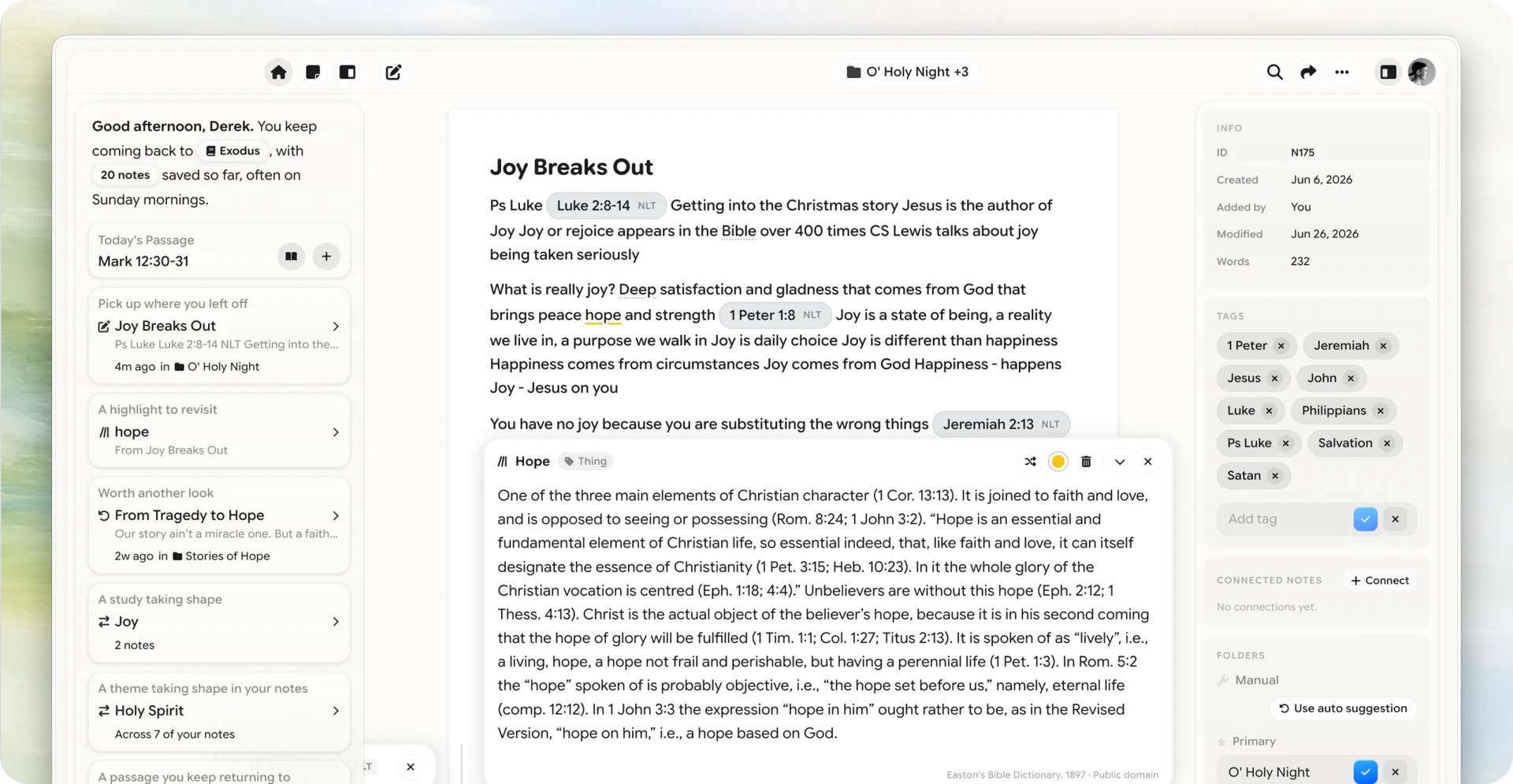
So here is the whole of what a church on Harvous can see about the people connected to it.
How many people are connected. How many follow each ministry channel.
That’s it. Two numbers, and a version of the second one per channel.
No names. No per-person anything. Not who wrote, not what they wrote, not whether they opened the study at all, not a summary, not a trend line with someone’s face on it. There is no report to run, no export, no admin toggle that turns it on. There is no way to ask for it, which is a different and stronger thing than choosing not to show it.
I want to be clear that those two numbers are genuinely useful. A ministry that reaches ninety people looks different from one that reaches four, and a church that plans a youth channel nobody follows should probably know that. That’s a real question about a ministry, and it can be answered without knowing one thing about any individual.
Almost every question a church actually needs answered turns out to be that kind of question.
What oversight actually needs
I want to be careful here, because there is a real thing on the other side of this.
Pastors are given something to watch over. That’s not a management structure someone invented — elders are told to shepherd the flock among them, watching over it willingly rather than lording it over anyone, and the people I know who carry that carry it heavily. It doesn’t evaporate because a tool declines to help with it.
But look at what that oversight is actually made of. It’s knowing that a family has stopped coming and calling to find out why. It’s noticing someone is quiet in a way they weren’t in March. It’s the elder who can tell you which member is carrying something, because they sat with them.
None of that is available through a reading log. What a dashboard offers isn’t oversight — it’s a proxy for oversight, and a bad one. It will tell you someone opened the study every week and tell you nothing about the fact that they’ve stopped praying. It will flag someone who hasn’t opened anything in a month who is, in fact, fine.
The risk isn’t only that the proxy is wrong. It’s that it’s easier than the real thing, and it will quietly get used instead of it. A number you can check on Tuesday morning will beat a conversation you have to schedule, every time, for anyone tired enough. And pastors are tired.
I’d rather not build the thing that makes the shortcut available.
Why a suggestion has a name
There’s exactly one exception, and I want to name it rather than let someone discover it.
Anyone connected to a church can suggest a resource for its shelf — a commentary, a talk, a book that helped. That suggestion carries your name.
It has to. A pastor can’t consider a suggestion, or say yes or thank you or “actually here’s why not,” without knowing who sent it. An anonymous suggestion box isn’t a kindness; it’s a hole in the wall.
The difference is that you chose to send it. You pressed a button knowing it goes to a person. That’s the entire boundary: what a church knows about you is what you decided to hand it.
And nothing about church features shows up at all for someone who hasn’t connected a church in their settings. If you use Harvous for your own study and want no part of any of this, you’ll never see it exists.
Trust is a design decision
The tempting way to handle all of this is a settings page. Let each church decide. Let each person opt out. Ship the dashboard, put a toggle on it, call it flexibility.
I don’t think that works, for a reason that has nothing to do with software. A privacy setting is only as good as the least comfortable conversation it can produce. If the report can exist, then somewhere there’s a member who knows the toggle is there, doesn’t know how it’s set, and can’t ask without it sounding like an accusation. The setting doesn’t remove the question. It just makes the person carry it.
So it isn’t a setting. It’s a thing the product cannot do, and that I can say plainly in a sentence, in public, where a church can hold me to it.
Which means this is one of the few promises here I can’t quietly soften later. That’s on purpose too. The faith.tools guidance for AI apps puts a version of it well — a tool built near someone’s faith should stay legible as a tool, and shouldn’t insert itself where a person belongs.
A church gets to know it’s reaching people. A person gets to write the true sentence. I haven’t found a case yet where a church needed more than that, and I’d want to hear about it before I believed one existed.
If you want the practice essays under this belief, tools help; humans teach is the wider version, and what church education systems need is what to build instead.