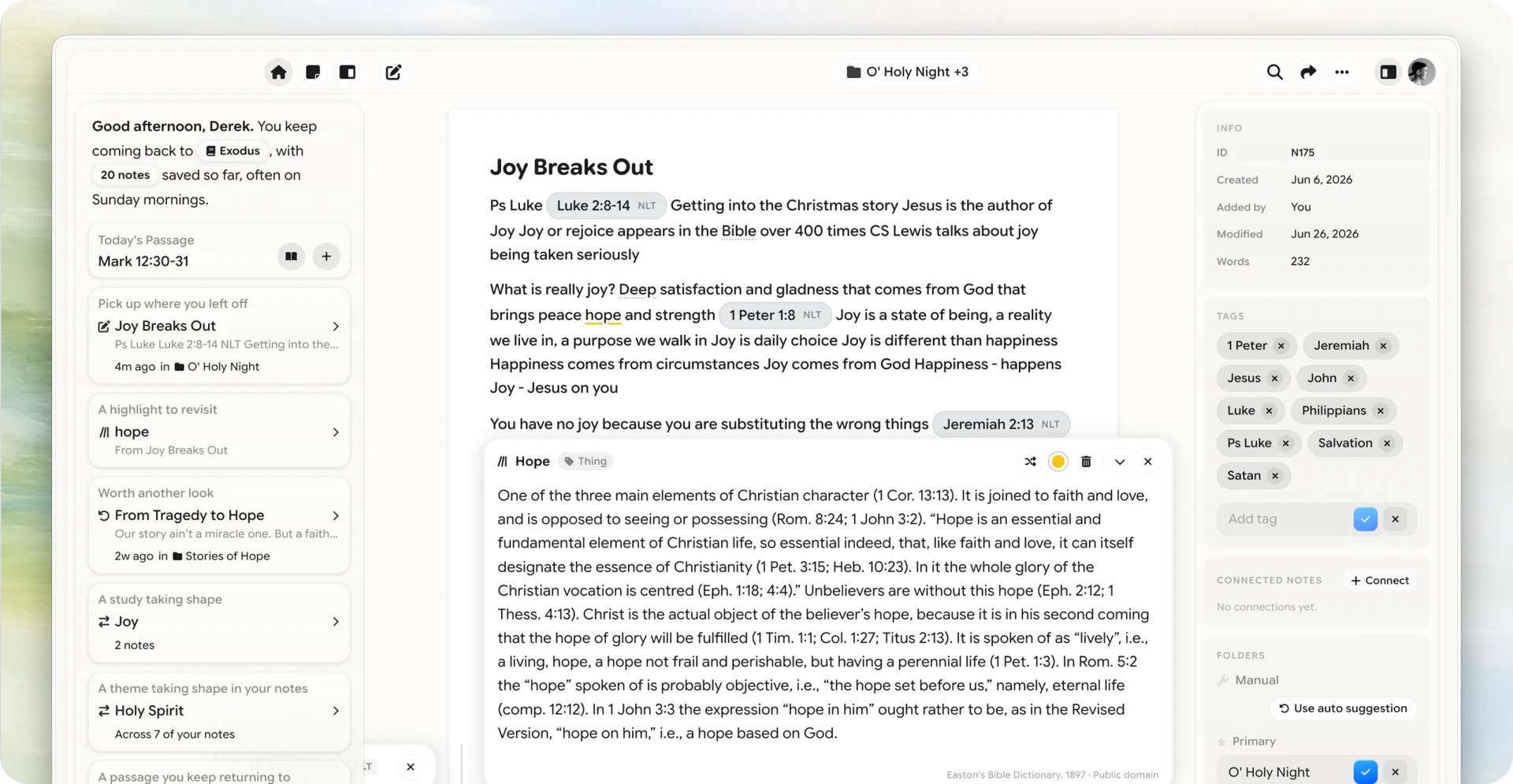
Tools help. Humans teach.
A field note on why Harvous exists for church education—and what we refuse to become.
I keep coming back to a sentence that sounds small until you build software near people’s faith:
Humans help humans. Tools only help.It’s not a slogan we workshopped for a landing page. It’s a boundary. It decides what Harvous is allowed to be—and what it must never pretend to be.
The temptation near Scripture
If you make tools for Bible study, you will be tempted to make them do the holy parts.
Summarize the passage so nobody has to struggle. Generate the lesson so the tired teacher can sleep. Answer the hard question so the group doesn’t sit in silence. Replace the mentor with a feed.
Some of that is marketed as compassion. Sometimes it is. Often it’s just speed wearing a gentle font.
Speed isn’t evil. Speed that removes the human search can still be a loss.
Proverbs 25:2 sits near the center of how I think about this:
It is the glory of God to conceal a matter; to search out a matter is the glory of kings.
Harvous is named with harvest in mind—and with searching in mind. I’m not hanging a whole product theology on one verse; I am letting that proverb keep us humble. The tool should serve the search, not replace the searcher.
What we mean by church education
When we say education for the church, we mean:
- Believers study and keep what they learn
- Teachers prepare and leave trails
- Groups continue conversations across weeks
- Churches organize continuity without becoming a machine that manages souls
We do not mean:
- An AI pastor
- A content mill that displaces local teachers
- A system that treats the gathered body as optional
The church is a people. Tools are furniture. Furniture can be well made. It should not demand worship.
Notes as the right primitive
I care about notes because notes are humble.
A note doesn’t preach for you. It doesn’t graduate you. It doesn’t award badges for holiness. It just keeps the thought you almost lost—next to the verse it belongs to.
That’s enough to change teaching. When a teacher’s trail survives Monday, next week can be continuation instead of amnesia. When a group’s questions are remembered, people feel known. When a sermon series has a findable spine, the whole church can walk together a little longer.
If you want the practice side of this, start with why church education evaporates by Monday and the lesson-prep stack. This post is the belief underneath those practices.
A line we try not to cross
We’re willing to be useful.
We’re unwilling to become a substitute for pastors, friends, parents, or the slow work of sitting under Scripture with other people.
The faith.tools guidance for AI apps says similar things in another register: don’t replace human relationships or spiritual practices; don’t fake Scripture; stay identifiable as a tool. Even where Harvous isn’t “an AI app” in the chatbot sense, that humility is the right neighborhood.
Building or teaching beside us
Whether you use Harvous or a paper notebook:
- Let tools carry memory
- Let people carry care
- Let Scripture carry authority
- Let the church remain a body
That’s the order.
Tools help. Humans teach. I’m glad you’re here doing the human part.