The lesson-prep stack
A reusable framework for teachers and group leaders: passage, aim, questions, trail, return. Copy it. Bend it. Make it yours.
Teachers don’t need another inspirational quote about preparation.
You need a stack—a small set of layers you can run every week without reinventing your process from scratch.
This is one. Steal it. Rename the headings. Ignore a layer when the week is brutal. The point is repeatability, not perfection.
The stack (five layers)
1. Passage
Write the text you’re teaching with enough precision to find it later.
- Good: John 15:1–11
- Weak: “John 15” or “the vine chapter”
If the lesson spans chapters, list the ranges you’ll actually open. Future search (and future you) depends on this.
2. Aim
One sentence. What should still be true for the room by Wednesday?
Aim is not a sermon title. It’s the spine of the trail.
If you’re stuck, finish this line: If they only remember one thing, let it be…
3. Questions
Two is enough for most hours.
- See: What do we notice in the text?
- Seek: What is this saying about God, us, or the world?
- Optional third for application-heavy groups: Step: What is one honest response this week?
Write the questions into the same note as the passage. Don’t leave them in your head or on a sticky note on the podium.
4. Trail
This is the layer most prep systems skip.
Trail means: what will this note still be useful for after class?
Include:
- Key cross-references you actually used
- A phrase or image that landed
- Names of themes tying to last week (not gossip—patterns)
- Links or handouts worth keeping
Trail turns a lesson into a thread.
5. Return
Before you close the week, decide the smallest midweek return.
Examples:
- Reread the aim sentence on Tuesday
- Text the group one question on Wednesday
- Open the same passage for five minutes before next prep
Return is how learning lasts. Retrieval practice research keeps saying the quiet part out loud: bringing something back beats highlighting it once.1 Church education often highlights beautifully and retrieves rarely.
Template you can copy
That’s the whole stack. It fits on one screen. It doesn’t require a binder system.
How to use it with a curriculum
If your church hands you a quarterly:
- Let the curriculum set the passage and pacing.
- Run the stack anyway—especially Aim, Trail, and Return.
- Treat publisher questions as raw material, not destiny. Rewrite them in your voice for your people.
Curriculum is a map from somewhere else. The stack is how you leave footprints on your path.
How to use it in a notes app
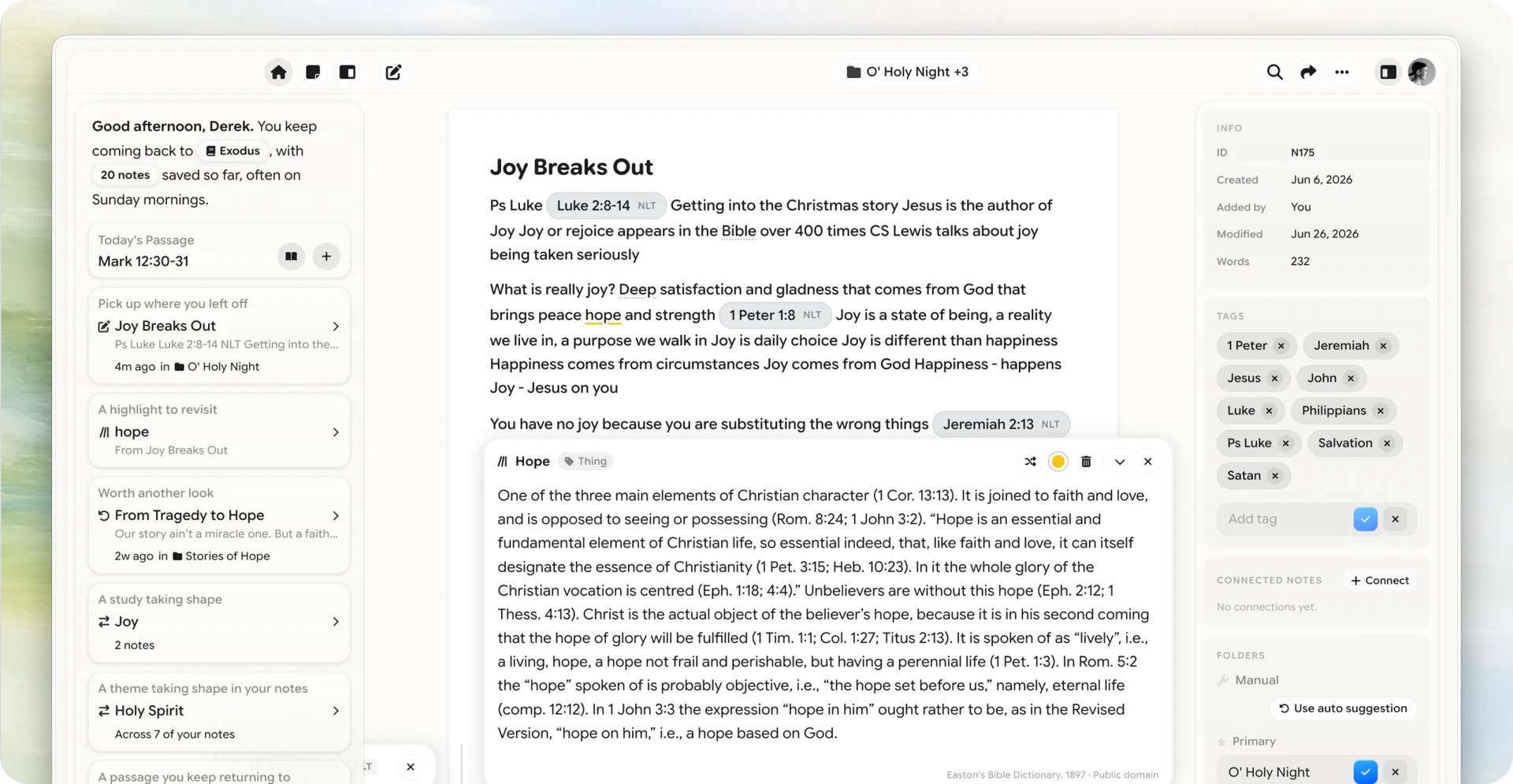
Put each week’s stack in a note linked to the passage. Over a quarter, you’ll have a chain you can actually browse.
Threads help when a series has a name (“Sermon on the Mount,” “James,” “Advent”). The stack still lives at the verse level so you’re never one folder rename away from losing everything.
If you want a notes hub that sits beside the Bible app you already use, Harvous for teachers is aimed at exactly this kind of weekly work.
What the stack is not
- Not a demand that every class become a seminary lecture
- Not a productivity system for spiritual life
- Not a replacement for prayer, listening, or knowing your people
Humans teach humans. The stack only helps you keep what the teaching already produced.
Try it for four weeks
Don’t evaluate the stack after one chaotic Sunday. Run it for a month.
After four weeks, ask:
- Can I see the arc of what we’ve been learning?
- Did any midweek return actually happen?
- Did prep get faster because I wasn’t starting from zero?
If yes, keep it. If one layer is dead weight, cut it.
A framework only earns its place when it makes teaching more faithful and less foggy—not when it makes you look organized.
Next up in this lane: teaching through a book for when the stack becomes a series.
Footnotes
-
Practice testing and spaced practice are among the strongest classroom-ready techniques in learning research — see this APA teacher-ready review (PDF). ↩