When co-leaders share a trail
Co-teachers and substitute leaders shouldn’t rebuild the room from a PDF. A shared trail keeps continuity when more than one person teaches.
Two people are supposed to lead the same class.
One preps this week. The other covers next month. Or they tag-team every Sunday—one opens the text, one watches the room, both try to remember what landed last time.
What usually gets shared is a file: last quarter’s questions, a slide deck, a Drive link with “FINAL” in the name.
What usually doesn’t get shared is the trail: which question opened this room, which passage still feels unfinished, which pastoral note the next leader needs before they walk in.
That’s the co-leader tax. Not conflict. Amnesia with good intentions.
The co-leader tax
Solo teaching already fights forgetting. Co-teaching multiplies it.
Each leader keeps a private version of the series in their head. The handoff becomes a text: “We did James 2, ask about favoritism, they liked the story about work.” Helpful. Incomplete. Gone by the third rotation.
Substitutes feel it hardest. They inherit content and walk into a room that already has history. Without a trail, they teach as if week one never happened—or they apologize for not knowing what everyone else remembers.
If handoffs erase continuity when one leader steps down, co-leading is the slow version of the same problem—weekly, quieter, easier to ignore.
What both need
You don’t need a shared memoir. You need a shared minimum:
- Where we are (passage + one aim sentence)
- What stuck last time (one or two keepers)
- What’s still open (one question worth returning to)
- Anything pastoral the next leader should know (careful, not gossipy)
That’s the same spine as a lesson-prep stack—just visible to more than one person.
Write it where both leaders already look when they prep. If it only lives in one person’s Notes app, it isn’t shared. It’s hoped-for.
One shared trail
Pick one place. Agree that this is the trail.
Not three chats. Not “I’ll email you my notes.” One living note (or thread) for the series, with a short entry per week.
A simple weekly shape:
- Before — the aiming leader posts passage + aim
- After — either leader adds what stuck and what’s open (five minutes)
- Before next — the other leader reads that before they prep
You’re not creating bureaucracy. You’re refusing to make the next human rebuild from zero.
Learning that isn’t kept isn’t learning—and teaching that isn’t handed off isn’t continuity.
Not another binder
Churches love binders. Binders die in closets.
Prefer a trail tied to Scripture and the actual series over a parallel filing system nobody opens between Sundays. Keep Planning Center for people and rooms. Keep your Bible app for reading. Add a working library for what the class has already walked through.
When PDFs aren’t a trail, the fix isn’t a better PDF. It’s continuity the next leader can reopen.
When Spaces help
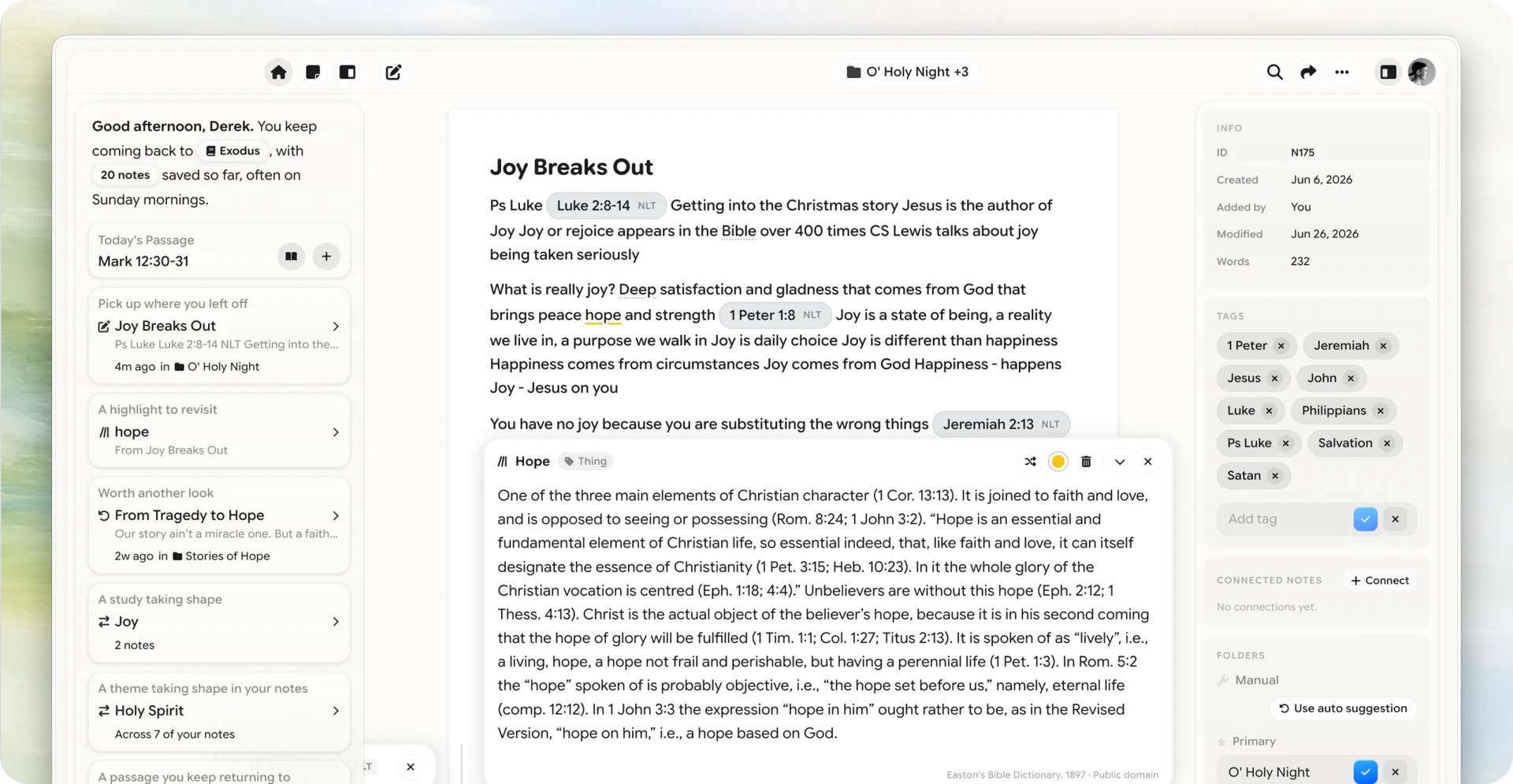
If both leaders (and, optionally, the group) already live in Harvous, Shared Spaces are a natural home for that trail: one space for the class, a thread per week, notes both leaders can add to. Private prep stays private until someone chooses to share it. Hosting is Plus; joining is free.
You can practice the habit without the feature. A shared note in whatever tool you’ll both open still beats a Drive folder named Spring 2026 v3.
The product is optional. The principle isn’t: co-leaders need one trail, not two parallel memories.
If you teach with someone else—or you are the someone else covering next month—start smaller than a new system. Agree on the four lines above. Write them somewhere both of you can find. Then teach the hour you have.
Teachers and group leaders already carry enough. Continuity shouldn’t be another invisible job that only one person remembers to do.