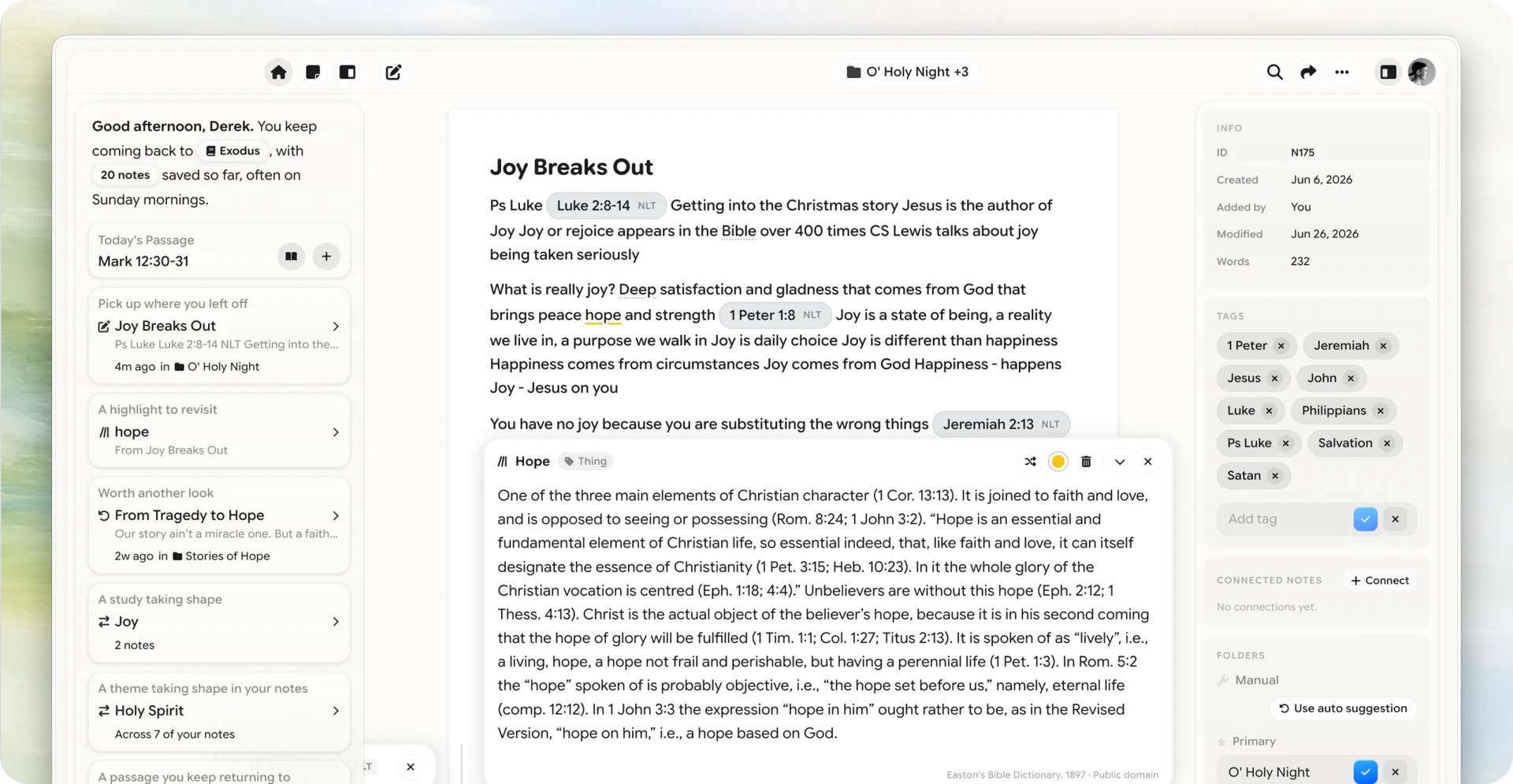
Asking better questions in class and group
How teachers and group leaders can ask questions that open Scripture—without turning the room into a quiz bowl or a therapy circle.
A good question can open a passage.
A bad question can close a room.
Most of us learned questioning by imitation: the leader asks something with a clear “right” answer, waits 1.5 seconds, then answers it themselves. Or we swing the other way—questions so vague (“How did that make you feel?”) that the text becomes optional.
Better questions are a craft. You can practice them. You don’t need a personality transplant.
What a study question is for
In class or group, a question should help people:
- Look at the text again
- Think with the text, not around it
- Speak as humans in a room—honestly, kindly
If a question can be answered without the passage open, it’s probably not a study question. It might still be a pastoral question. Just know which one you’re asking.
Three kinds that earn a place
Observation — “What do you notice?”
Low shame. High return. Especially good for mixed rooms (new readers and long-time readers together).
Examples:
- What repeated words or ideas do you see in these verses?
- Who is speaking, and to whom?
- What surprises you if you read it slowly?
Meaning — “What is this saying?”
This is where people fear being wrong. Make it safe by asking for possible readings and by returning to context.
Examples:
- Given what came before, what does this sentence seem to be doing?
- What would the first hearers have found comforting—or difficult?
- Where does this push back on a shallow reading of the chapter?
Response — “What is ours to carry?”
Keep this proportionate. Not every text wants a five-point life plan by 8:45 p.m.
Examples:
- What is one honest response this week—without pretending we’re done with the passage?
- Who in your life comes to mind as you hear this—and how will you pray, not perform?
- What might obedience look like in ordinary hours, not only dramatic ones?
Habits that improve questions
Write them before you improvise. Improvisation is fine; amnesia isn’t. Put two questions in your lesson-prep stack so the trail includes what you intended to ask.
Prefer fewer. Two strong questions beat eight mediocre ones. Dead air is not failure. It’s space.
Ask the text to referee. When answers diverge, smile and say: “Let’s look again at verse 7.” The Bible stays the center; you stay the guide.
Catch the live ones. The best question of the night often comes from someone in the third row. After class, add it to your trail note. That’s how your questioning craft compounds.
Don’t use questions as traps. If you already have a single acceptable sentence in mind, consider teaching that sentence plainly instead of playing “guess what I’m thinking.”
What to avoid (gently)
- Rapid-fire quiz questions that reward the quickest talker
- Questions that demand vulnerable disclosure from people who just met
- Questions that smuggle your sermon back in as “discussion”
- Questions that treat doubt as a problem to eliminate in ten minutes
Curiosity and care can sit together. I’m not saying Psalm 139:23–24 is a small-group method—it’s a prayer of honest searching before God. (See Psalm 139:23–24.) The tone still helps: invite real looking without turning anyone’s questions into a spectacle. Your group isn’t a stage; it’s a place where searching is allowed.
A practice for four weeks
Each week, prepare:
- 1 observation question
- 1 meaning question
- 0–1 response question
Afterward, rate them privately: Which one actually sent people back to the page? Keep that kind. Retire the ones that only produced polite fog.
If you teach or lead regularly, keep those questions next to the passage so next quarter’s you can learn from this quarter’s room. Teachers and group leaders both need that memory.
Better questions won’t make you impressive. They’ll make the text more audible—and the people more present.