Teaching through a book
A playbook for leading a class or group through a book of the Bible—without losing the plot by chapter four.
Teaching a single lesson is hard.
Teaching through a book is a different sport. You’re not only preparing an hour—you’re holding an arc across weeks while life interrupts half your group and someone new shows up in week six asking what they missed.
This is a playbook for that work. Not the only way. A way that leaves a trail.
Why book studies fall apart
Most book studies don’t fail because the Bible is too hard. They fail because the container is weak:
- No visible map of where you’ve been
- No shared “so far” sentence the group can re-enter
- Prep that treats each week as a standalone episode
- Notes scattered across emails, printouts, and memory
By chapter four, you’re relying on vibes and the loudest recollection in the room.
Build a series spine
Before you open week one’s detailed prep, write a one-page spine:
- Book + audience — Who was this written to, in a sentence ordinary people can hear?
- Arc — What movement do you hope the group feels across the whole study?
- Section plan — How you’ll chunk it (by chapter, scene, or argument)
- Open chair policy — How newcomers catch up without derailing everyone
- Trail home — Where the series notes will live
You can revise the spine later. You just don’t want to invent it every Tuesday night.
Week structure that compounds
Pair the lesson-prep stack with two series-only habits:
The “so far” opener (3 minutes)
Start most weeks with: Where have we been?
Keep a running “so far” sentence in your series note and read it aloud. Invite one person to add a detail. This is retrieval practice in church clothes—and it works for the same reasons retrieval practice works in classrooms.1
The handoff closer (2 minutes)
End with: What should still be in our hands by next week?
One sentence. Optional: one verse to reread. Not a homework packet.
Notes for a navigable study
For a book study, organize at two levels:
Series thread — James; Gospel of Mark; Exodus.
Passage notes — James 1:1–18; Mark 4:35–41; each week’s text.
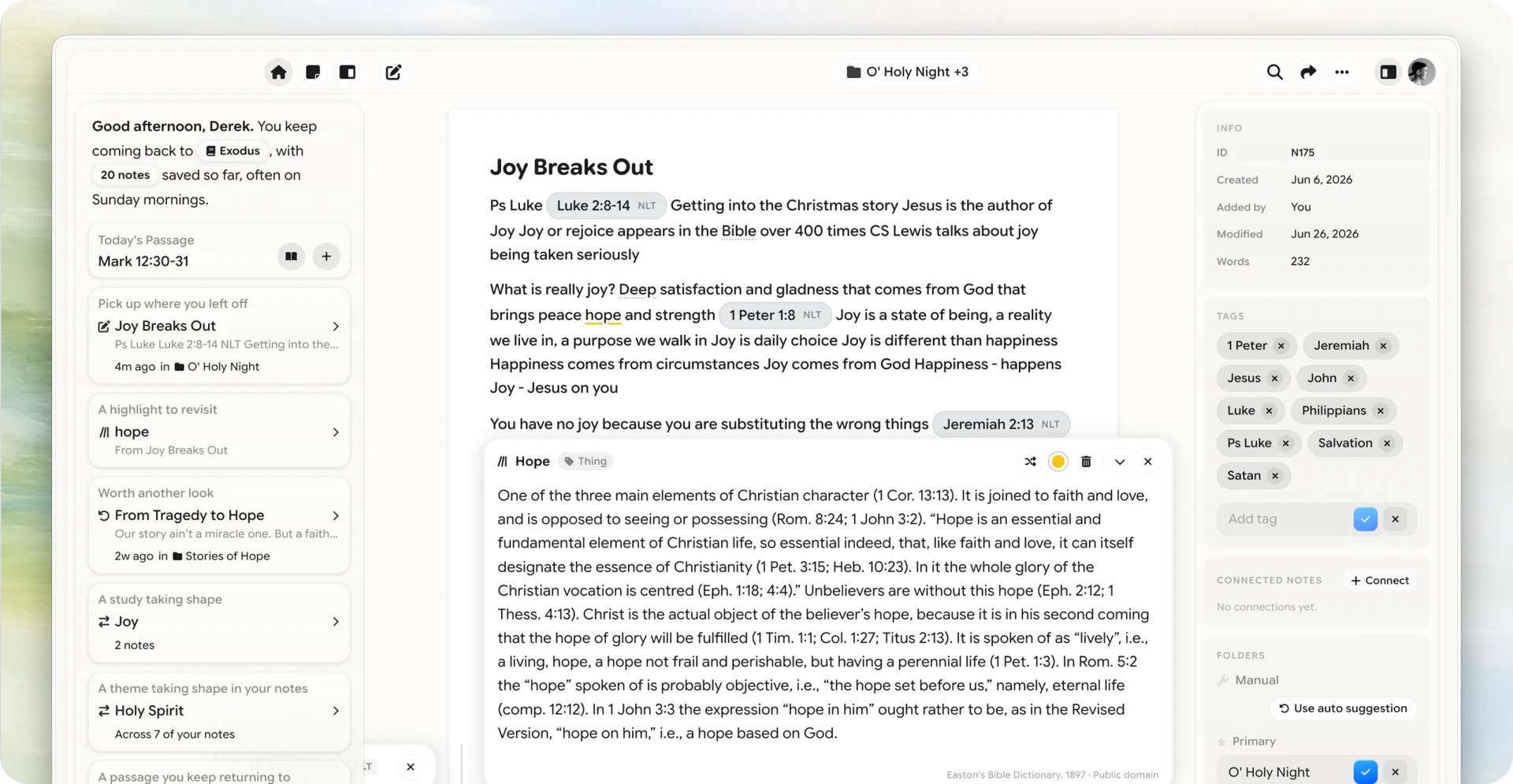
Your series thread holds the spine, the “so far” sentence, and links across weeks. Your passage notes hold the actual teaching trail.
When someone asks in week nine, “Didn’t we talk about trials already?” you can find it—because it’s attached to James 1:2–4, not buried in Group_Notes_Spring.pdf.
What to do when you get behind
You will get behind. Holidays, funerals, a wild discussion that was worth it.
Don’t punish the group with a speed-run. Do this instead:
- Update the spine honestly (“We’re combining 3:1–12 and moving the next section”)
- Keep the “so far” sentence accurate
- Capture what you skipped as a short note—for later, not for shame
A book study is shepherding a pace, not completing a syllabus for a grade.
Curriculum vs. open Bible
Using a guide book? Great. Let it help with background and questions. Still keep your series spine and trail. The guide doesn’t know your people’s unfinished conversations.
Going open Bible with no publisher guide? Also great. Your spine has to work harder. Write more “so far.” Ask fewer questions. Protect the arc.
A simple starter kit
For your next book study, create:
- One series note with the spine
- Week-one passage note using the prep stack
- A promise to yourself: update “so far” before you prep the next week
If you want that trail linked to Scripture in one place, Harvous for teachers, group leaders, and seminary students are built for this kind of long obedience in the same direction.
Teaching through a book isn’t about covering pages. It’s about helping people stay inside a story long enough for it to change how they see.
Footnotes
-
Practice testing and spaced practice are among the strongest classroom-ready techniques in learning research — see this APA teacher-ready review (PDF). ↩