Remembering is the point
Bible study isn’t linear, and notes aren’t the goal. Why Harvous is built so what you find can become a study Bible you actually return to.
I’m called to make Harvous. What matters more to me than that sentence is simpler:
Someone remembers their Bible study.Not that they opened an app. Not that they produced a tidy stack of notes. That what they found in Scripture—and in the room with other people—is still findable when life moves on.
That’s the difference. Notes can be busywork. Remembering is the point.
Notes aren’t the goal
There’s a version of “Bible study software” that treats note-taking as the product.
You capture. You file. You feel productive. Then next month you can’t find the thought that actually mattered—or you never reopen it, because the note was never meant to live beside the verse it came from.
Real study isn’t a straight line either. A Sunday sermon lands a question. Tuesday’s reading answers half of it. Small group opens another door. Prep for next week sends you back to the same passage with different eyes. Discoveries show up out of order. They collide. They wait.
If a tool only helps you take notes, it can still lose the trail. I want something closer to growing your own study Bible—over months and years—not a scratch pad that expires when the week ends.
Your own study Bible
When I say “your own study Bible,” I don’t mean a publisher’s margin notes with your name on the cover. I mean a living record of your searching: what you noticed, what you asked, what you taught, what your group discovered—kept where Scripture lives in your attention.
That’s why Harvous is shaped the way it is on purpose.
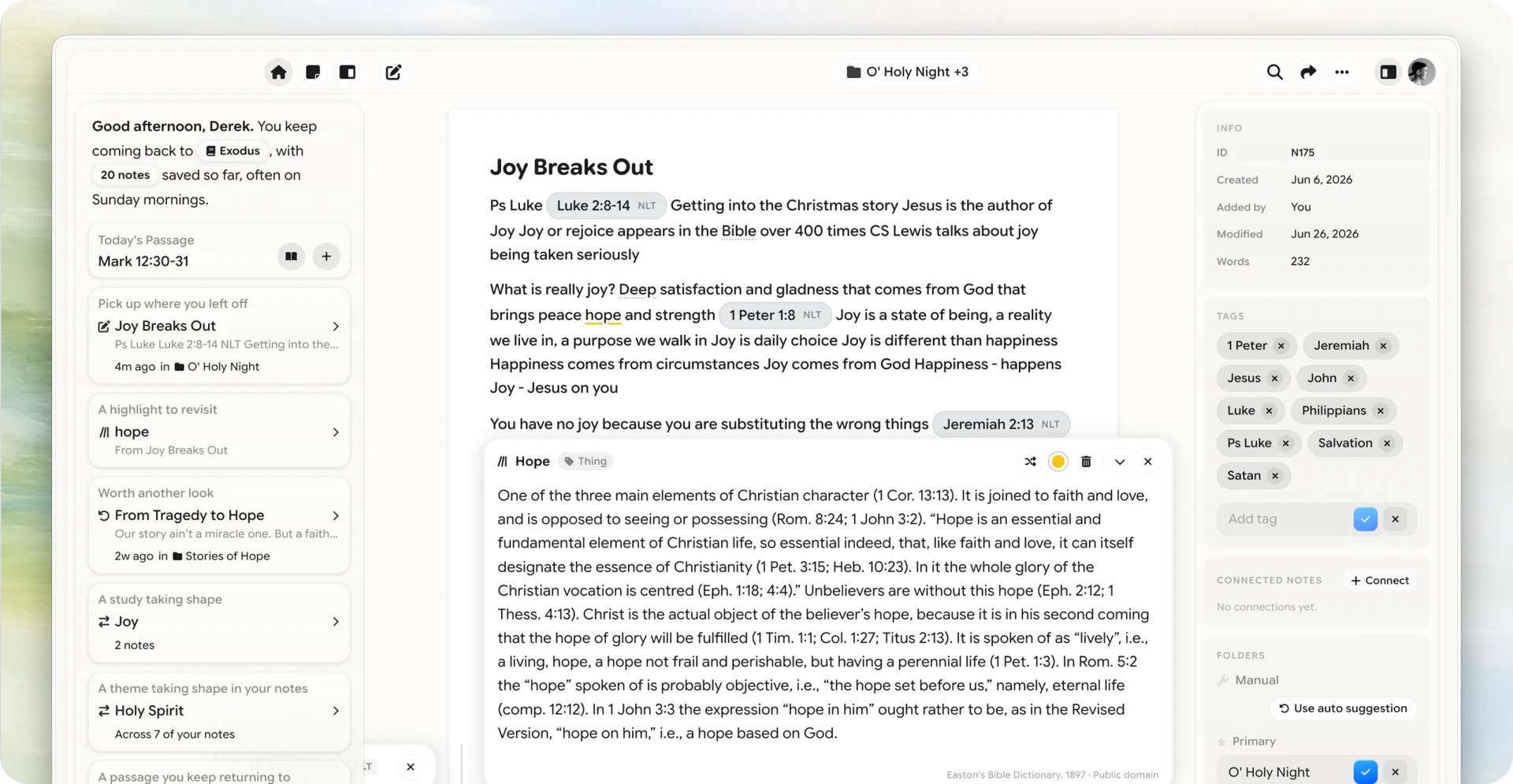
Keep your Bible app or your paper Bible. We’re not trying to replace the reader. We want a place for the trail: notes linked to the verses they belong to, threads you can return to, private prep that stays private until you’re ready to open it.
And when study needs more than a private notebook, Shared Spaces let a group keep the same threads. Personal study and group study aren’t two products. They’re the same non-linear life of learning, with different doors.
The design question underneath every feature is the same: does this help someone make it their own and actually return—or does it just help them take more notes?
Built for today and later
Today, Harvous is useful for personal Bible study that lasts: capture what matters, find it again, keep teaching and quiet time from starting at zero.
That’s intentional. It’s also incomplete on purpose in the best sense: the foundation has to be a trail people trust before a church can organize around it.
The longer aim is church education that doesn’t evaporate—teachers who leave a spine, groups that continue across weeks, people who lead study without rebuilding from a PDF every quarter. We’re not shipping a ChMS. We’re not replacing the gathered body. We’re building furniture for memory and continuity.
The church layer has since arrived: a teaching plan for each ministry, a series that holds its weeks, and a shelf of what a church teaches from. Churches come on by request while it’s young. What’s still ahead I’ll name as direction rather than promise—Review, so practice can come from your own notes, and Challenges for guided seasons. The product should earn the next layer by serving the search you already do.
If you want the practice essays beside this belief, start with tools help; humans teach and keep what the group finds.
Whether you use Harvous or a paper margin:
Bible study is complex. It’s also worth remembering as time goes on.
I’m not trying to win a category called “notes.” I’m trying to help the finding stick—so next week’s prep, next year’s series, or Monday’s reread doesn’t start from scratch.
Remembering is the point. The rest is how we try to get there.