Prep a lesson that leaves a trail
Teaching prep shouldn’t vanish when class ends. A simple way to prepare so next week can build on this week.
Most lesson prep is built for delivery.
You open the passage. You outline talking points. You find a story, a question, maybe a video. You walk into the room ready to lead.
Then class ends, and the prep has nowhere to go. The outline lives in a Google Doc titled Lesson 4 FINAL v2. The cross-reference that mattered is in a margin you’ll never search. The question that actually opened the room isn’t written down at all—because it showed up live.
Next week, you’re starting cold again.
There’s a better aim for prep: not just how will I teach this hour? but what trail will this hour leave?
Prep for the room and the return
Delivery prep asks: What do I say?
Trail prep asks: What should still be findable later—for you, and maybe for them?
Those aren’t enemies. They’re two layers of the same work.
| Delivery prep | Trail prep |
|---|---|
| Outline for speaking | Passage + one-sentence aim |
| Icebreaker | The question that defines the week |
| Illustrations | Links between this text and last week’s |
| Timing | Notes on what the room actually did |
You still need delivery prep. You’re a teacher, not a filing cabinet. But if delivery is the only layer, your best work evaporates with the whiteboard markers.
The trail layer is what makes return possible later—for you next week, and for the room if they ever reopen the text.1
A trail-minded prep flow
Here’s a flow that fits a busy week without pretending you have seminary research hours.
1. Start with the text, not the tip
Read the passage you’re teaching. Write the reference at the top of your note—with verses, not just “Romans 8.” You’re building something you can return to.
If a cross-reference pulls you, write it as a real reference too (Romans 8:1–4, not “see also Romans 8”). Future-you will thank present-you.
2. Name one aim in one sentence
Not five objectives. One.
Examples:
- “See that there is no condemnation for those in Christ—and what that frees us to do.”
- “Watch how Jesus treats the overlooked person in the story.”
- “Notice what prayer looks like when the answer is slow.”
If you can’t say the aim in one sentence, the lesson will struggle to leave a trail. The trail needs a spine.
3. Choose two questions, not twelve
One observation question (“What do you notice?”). One meaning-or-response question (“What does this press on us?”).
Write them where you’ll still see them after class. The best question of the night is often the one you didn’t plan—add that to the trail afterward.
4. Leave space for the room
Your prep note should have a blank zone labeled something honest like What actually happened. After class, spend three minutes filling it in. That’s the difference between a script and a living thread.
Why linked notes help teachers
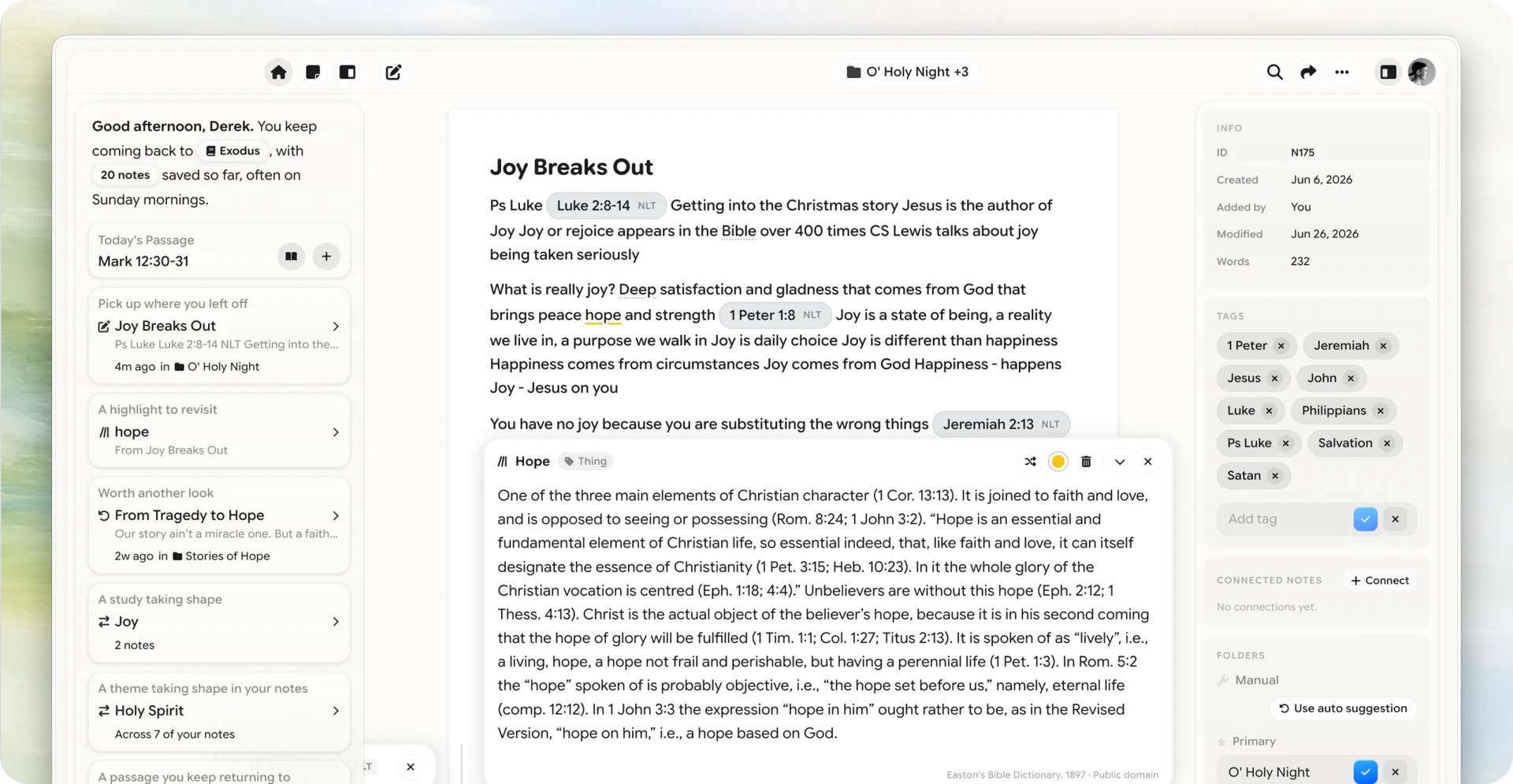
When your prep lives next to the passage, you’re not hunting through folders named after quarters and series titles. You’re hunting by the text you’re teaching.
That’s especially useful when:
- Last month’s class suddenly connects to this week’s text
- A student asks about a verse you covered lightly before
- You’re repeating a book study a year later and want your old trail, not a blank page
You can keep your Bible app. Keep your printed curriculum if it helps. The point isn’t replacing your tools. It’s giving the thinking a home that stays attached to Scripture.
Harvous for teachers is built around that idea: notes that know where they belong.
A note on curriculum binders
Published curriculum can be a gift. It can also become a substitute for your own trail—something you deliver and discard.
If you use a book or quarterly:
- Keep the curriculum for structure
- Keep your trail for what your people actually needed
- Capture the local stories, the pastoral edges, the questions unique to your room
The binder doesn’t know your group. Your notes can.
This week’s experiment
Before your next class, create one prep note with four headings:
- Passage
- One-sentence aim
- Two questions
- After class (leave blank)
Teach from it. Fill in #4 before you sleep. Next week, open that note before you start fresh.
That’s a lesson that leaves a trail—not because the teaching was louder, but because it had somewhere to go.
For a fuller template you can reuse every week, see the lesson-prep stack.
Footnotes
-
Practice testing and spaced practice are among the strongest classroom-ready techniques in learning research — see this APA teacher-ready review (PDF). ↩